
Business Growth · 17 Aug 2026 · 8 min read
How to Calculate Profit Per Field Service Job
Many service businesses know monthly revenue. Far fewer know which jobs actually made money after materials, labour, and travel.
A ₹10,000 service ticket is not ₹10,000 of profit. It is a customer payment that still has to cover parts, technician time, travel, and the extras that never made it onto the quote. Owners who only watch monthly collections often discover the leak at year-end, when cash feels tight despite a busy calendar.
Job-level profitability is the habit of reviewing each completed job as a small P&L: what you billed, what it cost to deliver, and what remains. You do not need a finance team to start. You need a consistent job record and the discipline to attach costs to that record before you close it.
TL;DR
- Revenue is what the customer paid. Profit is what remains after direct job costs.
- Quoted scope should carry into the operational job so you are not costing a different BOQ than you sold.
- Review profit after billing and payment — not only after the technician marks complete.
Revenue Is Not the Same as Profit
Revenue is the amount on the invoice. Profit is revenue minus the costs that belong to that job. A high-value installation can look healthy on the collection sheet and still be thin once you subtract the compressor, the helper overtime, and the second visit you did not bill.
This matters because owners often price from competitor quotes or from last year’s “round number,” then judge the business by bank balance. That hides mix: some job types subsidise others. Until you cost at job level, you cannot tell which customers, sites, or service types deserve a different price.
Direct costs are the ones that exist because this job existed. Overhead — rent, office salary, software — is real, but it belongs in a separate monthly view. Mixing overhead into every job before you can even name materials and labour usually stalls the process. Start with direct costs. Add a simple overhead share later if you want a fully loaded number.
The Five Costs Every Service Business Should Track
You do not need fifty cost codes. Five groups cover almost every field-service job. If a rupee moved because of this job, it belongs in one of them.
- Materials — parts issued from stock, filters, cable, devices, and anything purchased locally for the site.
- Technician / labour cost — time on site and reasonable travel time, using a loaded hourly rate (salary, statutory costs, not only take-home).
- Travel — fuel, tolls, parking, or a simple per-km allowance if that is how you run vans.
- Subcontractor or other job costs — hired specialists, crane, extra helper, or a one-off hire that only this job required.
- Discounts, refunds, and callbacks — the amount you gave away, plus the cost of a revisit that was not billed.
Example: A ₹25,000 Installation Job
The numbers below are an illustration, not a benchmark. Use them to see the shape of the calculation, then replace every line with your own rates and SKUs.
| Line | Amount (₹) |
|---|---|
| Customer revenue | 25,000 |
| Materials | 9,000 |
| Technician / labour | 4,000 |
| Travel / logistics | 1,000 |
| Other direct cost | 500 |
| Job profit | 10,500 |
Profit is 25,000 − 9,000 − 4,000 − 1,000 − 500 = ₹10,500. Margin is profit divided by revenue: 10,500 / 25,000 = 42%. That 42% is a direct margin, not a net profit after rent and office. If a callback the next week costs another ₹2,000 in labour and parts and you do not bill it, margin falls to 34% on the same original invoice.
Run this same table on ten recent jobs in one service type. You will usually see a spread: some jobs sit well above your target margin, some sit below because of extra materials or an unquoted visit. That spread is the management information. A single average hides it.
Why Material Leakage Changes Job Profitability
Materials are often the largest line after labour — and the easiest to lose between the store and the site. A part that leaves “with the technician” but never lands on the job still hit your purchase bill. The job then looks more profitable than it was.
Leakage shows up as unrecorded issues, wrong quantities, emergency purchases at retail prices, unused material that never returns, and parts used on a neighbouring job. Serialised equipment (an indoor unit, a camera, a controller) should be identifiable on the job you billed. Consumables still need a quantity against that job, even when they have no serial.
Emergency buys are not automatically bad. A same-day capacitor purchase can save the job. They become a profitability problem when they are invisible: paid in cash, forgotten, and never compared to the quote. If local purchases sat on the same job as stock issues, you would see whether the quote assumed a ₹400 part and the site consumed a ₹1,200 part.
For the operating habit — issue, return, reconcile — see how field teams lose money on spare parts. For the system side of attaching SKUs to work, start with inventory tied to the job.
Why Quotation-to-Job Continuity Matters
Costing a job that was retyped from a chat is costing a different job than the one you sold. Sales promised one bill of quantities. Ops typed another. The helper bought a third. Your profit review then argues with three versions of the truth.
The quoted customer, site, and line items should become the operational job. Then materials issued and time spent can be compared to what was priced. Variance is useful: extra cable, extra visits, a scope change the customer never signed. Variance without a shared document is just a feeling that “this site was painful.”
If quotations still live in a PDF folder, converting them into jobs with the same customer and site is the first profitability control. You cannot review margin on a job that does not know what was sold.
Build a Job-Level Profitability Process
Treat profitability as a weekly loop, not a year-end spreadsheet. The sequence is the same whether you run AC, RO, CCTV, or mixed facilities work.
- Quotation
- Job
- Materials
- Employees
- Completion
- Billing
- Payment
- Profit review
After payment — full or partial — sit with the job number and the five cost groups. You are not looking for accounting perfection. You are looking for jobs that consumed extra materials, extra visits, or a discount that was never priced in. Those jobs teach you what to change in the next quote.
Keep the review on the same operational record the office used to dispatch and the field used to close. A job record that already holds crew, status, and billing is easier to cost than a folder of chats plus an invoice number in a separate tool.
Outstanding amounts belong in the same loop. A profitable job that is not collected is a working-capital problem. Review profit and outstanding together so “we made money on paper” does not hide cash still sitting with the customer. Payments and purchase cost on that same job are covered in purchase and payments on the job spine.
Five Questions Every Owner Should Ask
Once you have even a month of job-level numbers, these questions beat a generic “we need to improve margins” conversation.
- Which jobs make the most money — by service type, not only by invoice size?
- Which jobs regularly consume extra materials versus the quote?
- Which technicians or job types generate the highest revisit costs?
- Which customers look busy but sit below your target direct margin?
- Which service types should be priced differently after you have seen the cost mix?
You will not answer all five in week one. Start with extra materials and unbilled revisits. Those two usually move margin faster than a new slogan on the quotation template.
How an Operations System Helps
A spreadsheet can run this process for a handful of jobs. It breaks when quotations, issues, attendance, proofs, and invoices live in different places. The system’s job is not to “guarantee higher profits.” It is to keep the commercial job, the field execution, the materials, and the bill on one record so a human can review them.
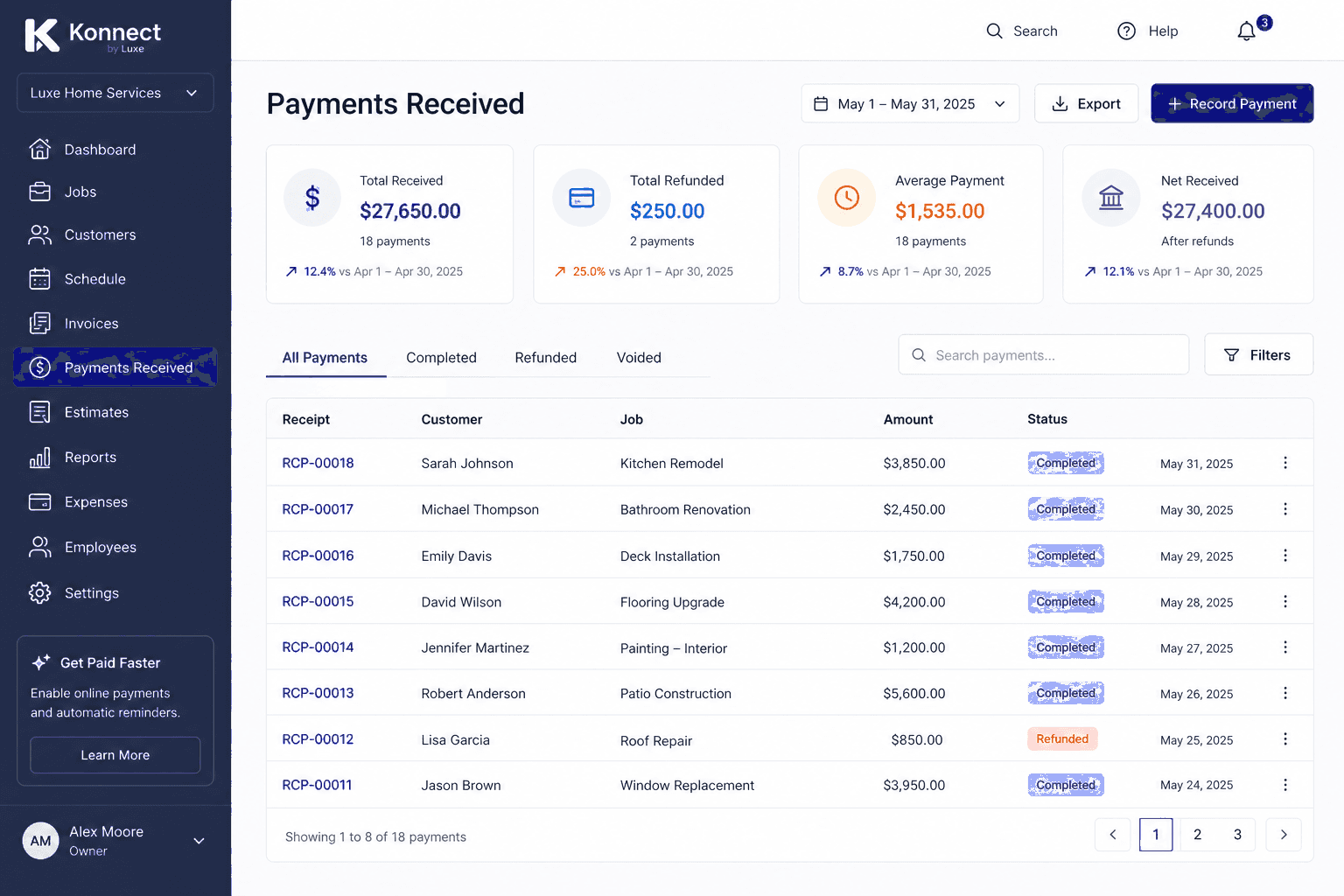
Konnect is built as that record: quotations that convert to jobs, materials and purchases against the job, employees and attendance beside dispatch, completion evidence before you bill, and payments against the same job number. Used that way, the weekly profit review is a look at work you already ran — not a reconstruction from WhatsApp.
FAQ
What is job profitability?
Job profitability is revenue for one service job minus the direct costs of delivering that job — typically materials, labour, travel, other job expenses, and discounts or refunds.
What costs should be included in field service job costing?
Include costs that exist because of that job: parts issued or bought, technician time, travel, subcontractors, and giveaways or unbilled callbacks. Keep rent and office overhead in a separate monthly view until the direct picture is stable.
How do you calculate field service profit margin?
Direct margin is job profit divided by job revenue. If revenue is ₹25,000 and direct profit is ₹10,500, margin is 42%. Say whether the number is before or after overhead.
Why are material costs important in service jobs?
Materials are often the largest controllable line. Untracked issues, emergency buys, and parts used on another job make the job look more profitable than it was and distort the next quote.
How can service businesses identify low-margin jobs?
Cost a sample of completed jobs in one service type, then sort by margin. Look for extra materials, extra visits, and discounts. Repeat monthly so mix changes are visible.