
Operations · 16 Aug 2026 · 8 min read
How to Stop Losing Money on Spare Parts in a Field Service Business
Inventory leakage rarely starts in the locked storeroom. It starts between issue and the completed job — where “the technician has it” replaces a record.
Most owners can tell you what they last purchased. Fewer can tell you which open jobs those parts are sitting on, which technician is carrying them, and whether unused pieces came back. The gap between purchase and consumption is where spare-part money disappears.
This is not a lecture about bigger warehouses. It is a control problem: every movement should have a job as the reference, and every job should be able to show what was allocated, issued, used, bought locally, and returned.
TL;DR
- The stockroom is rarely the first failure. Issue, van stock, and returns are.
- Possession is not accountability — “technician has it” is not a stock status.
- Serialised items and consumables both need a job reference, just different identifiers.
- Reconcile after the job, not only at month-end.
The Stockroom Is Not Where Most Inventory Problems Start
A locked cage with a register looks controlled. The leak is usually downstream: a handful of filters “for the round,” a camera taken “just in case,” a local buy that never enters stock, a leftover coil that stays in the van for the next society.
Follow the actual path of a part, not the org chart.
- Purchase
- Stock
- Allocation
- Technician
- Job
- Consumption
- Return
Each arrow is a chance to lose the thread. If any step is only a verbal instruction, you will spend month-end arguing with a physical count that cannot match the jobs you already billed.
The Five Common Sources of Spare-Part Leakage
When owners say “stock is always short,” it is usually one of these five, often several at once.
- Unrecorded issue — the part left the shelf and never hit a job or a technician record.
- Wrong quantity — two issued, one used, one vanished into van stock with no return.
- Emergency purchases — retail buys paid in cash and forgotten, so job cost and stock both lie.
- Unused material not returned — the job closed, the extra device stayed in a bag.
- Material used on another job — JOB-A was issued the camera that actually went to JOB-B.
None of these require theft to hurt you. Informal generosity between neighbouring sites is enough. The P&L still pays.
Why "Technician Has It" Is Not Inventory Control
Possession answers “who is holding the bag?” Accountability answers “which job is this reserved or issued against, and what should come back?” If the only status you have is a person’s name, you cannot close a job, cost a job, or count a store.
Van stock is legitimate. Many crews carry fast-moving consumables. It becomes a black hole when van stock has no list, no job allocation, and no return rule. Then every technician is a mini warehouse that never reports.
A practical rule: if it left the main store, it is either allocated or issued to a job, or it is a named van kit with a par level you actually count. “He has it” is none of those.
Serialized vs Non-Serialized Materials
Field inventory is not one behaviour. Mixing the two types in your head is how serialised equipment gets treated like cable.
Serialized items
Cameras, indoor units, controllers, meters, and similar devices have an identity. The operating need is: this serial was received, it sits in stock or on a job, and the completed job can show which unit was installed. Do not invent scanning theatre the product does not run. Do record the identifier on the job that will be billed.
Non-serialized items
Wire, clamps, tape, gas, filters without unique IDs are quantity items. You still issue a quantity to a job. You still expect unused quantity back or a written consumption. Batch information matters when you need expiry or lot traceability; use it where your process already keeps batches, not as decoration.
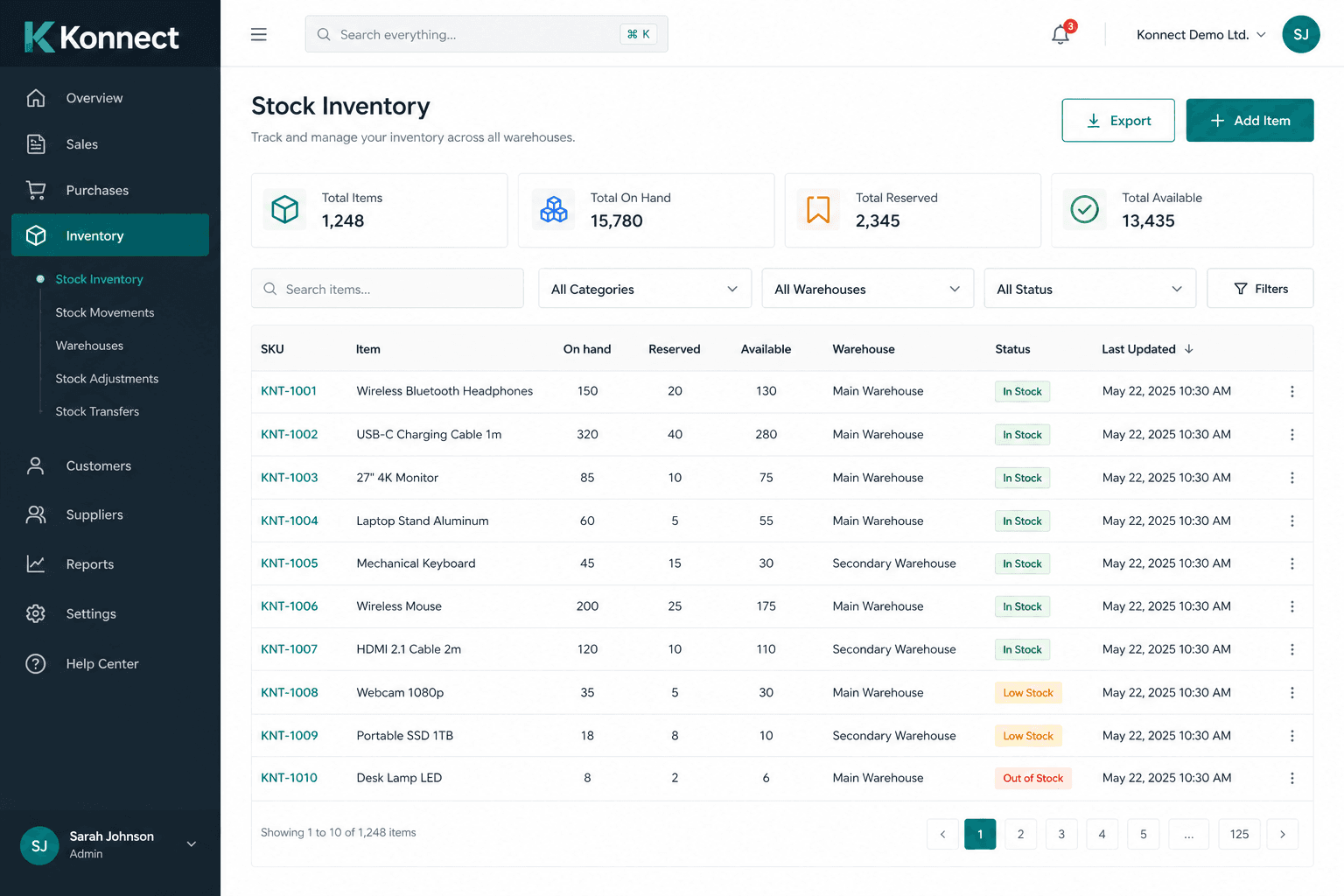
Konnect inventory is built around items, batches, reservations, and issues tied to jobs — not a separate GPS-style “parts app.” Keep the job as the spine and the item record as the quantity truth.
Attach Materials to the Job
The job number is the only reference office, store, and field can share without a conference call. Quotes, issues, local purchases, and the invoice should all be able to point at it.
When materials sit on the job you will complete and bill, three conversations get shorter: “what did we send?”, “what did we use?”, and “why is this job’s cost higher than the quote?”
If you still issue against a technician name only, you will keep discovering that the name did four jobs that day and the parts cannot be split.
Example: 100 CCTV Cameras Across Multiple Jobs
The following is an illustration for a CCTV installation business, not a claim about any one customer.
Buffer stock is fine. Unassigned buffer that technicians treat as personal kit is how the eighth “spare” becomes an unofficial fifth job.
A Better Spare-Part Control Workflow
You can run this on paper for a week to prove the idea. The sequence is what matters; the tool should follow it, not invent a parallel process.
- Purchase
- Receive
- Batch or serial
- Inventory
- Allocate
- Issue
- Job
- Consume or return
- Reconcile
Receive against the purchase so stock exists before anyone takes a unit to site. Allocate or reserve for upcoming jobs so two coordinators cannot promise the same 32 cameras. Issue to the job the crew will actually run. After completion, consume what was installed and return what was not. Reconcile: job materials versus physical remainder.
Local emergency buys should still land on that job — as a purchase linked to the work — so you are not costing a job that never saw the retail bill. That is the same spine described in inventory management for field jobs.
Five Inventory Metrics Owners Should Watch
You do not need a data team. You need five questions you can answer from job records and a count.
| Metric | What you are looking for |
|---|---|
| Material consumption per job | Cost and quantity versus the quote for that service type |
| Emergency purchase frequency | How often jobs buy retail because stock was wrong or missing |
| Unused material returns | Whether extras actually come back after completion |
| Material variance | Issued versus consumed versus returned |
| Job material cost | Direct parts cost on the job you billed |
If emergency purchases are frequent, the problem may be min/max levels — or it may be van stock that never reported. If returns are always zero, extras are becoming unofficial inventory. Those patterns also show up in job-level profit.
How Konnect Fits Into This Process
Konnect does not make leakage impossible. It makes leakage visible by keeping items, batches, reservations, issues, and job records together, and by letting a local purchase sit on the same job you will invoice.
Use it as the operational reference: receive into inventory, attach materials to the job, issue or buy against that job, close with what was actually used. The owner’s review is then a list of jobs and material lines — not a forensic reconstruction of last month’s vans.
FAQ
How do field service companies track spare parts?
Track movements against jobs: receive into stock, allocate or issue to a job, record consumption or return, and reconcile. Technician name alone is not a stock status.
How do you track materials used by technicians?
Issue quantity (and serials where they exist) to the job the technician is running. Van kits should have a par list. Unused items return to stock or stay as named van stock, not as an unnamed bag.
What is the difference between serialized and non-serialized inventory?
Serialized items have an identity (camera, unit, device) and should be traceable to a job. Non-serialized items are quantities (wire, clamps, many filters) issued and consumed by amount.
How can service businesses reduce inventory leakage?
Stop unrecorded issues, require a job on every issue and local buy, count returns after completion, and watch emergency-purchase frequency. Process first; software to hold the process.
Should spare parts be assigned to jobs?
Yes, if you want job cost, stock accuracy, and fewer site-to-site swaps. Assignment can be a reservation before dispatch or an issue when the crew leaves — both beat “with the technician.”