
Operations · 16 Aug 2026 · 8 min read
When Should a Field Service Business Stop Using WhatsApp and Excel?
WhatsApp and Excel are not bad tools. They become expensive when the business has more jobs, people, and parts than a chat thread can hold.
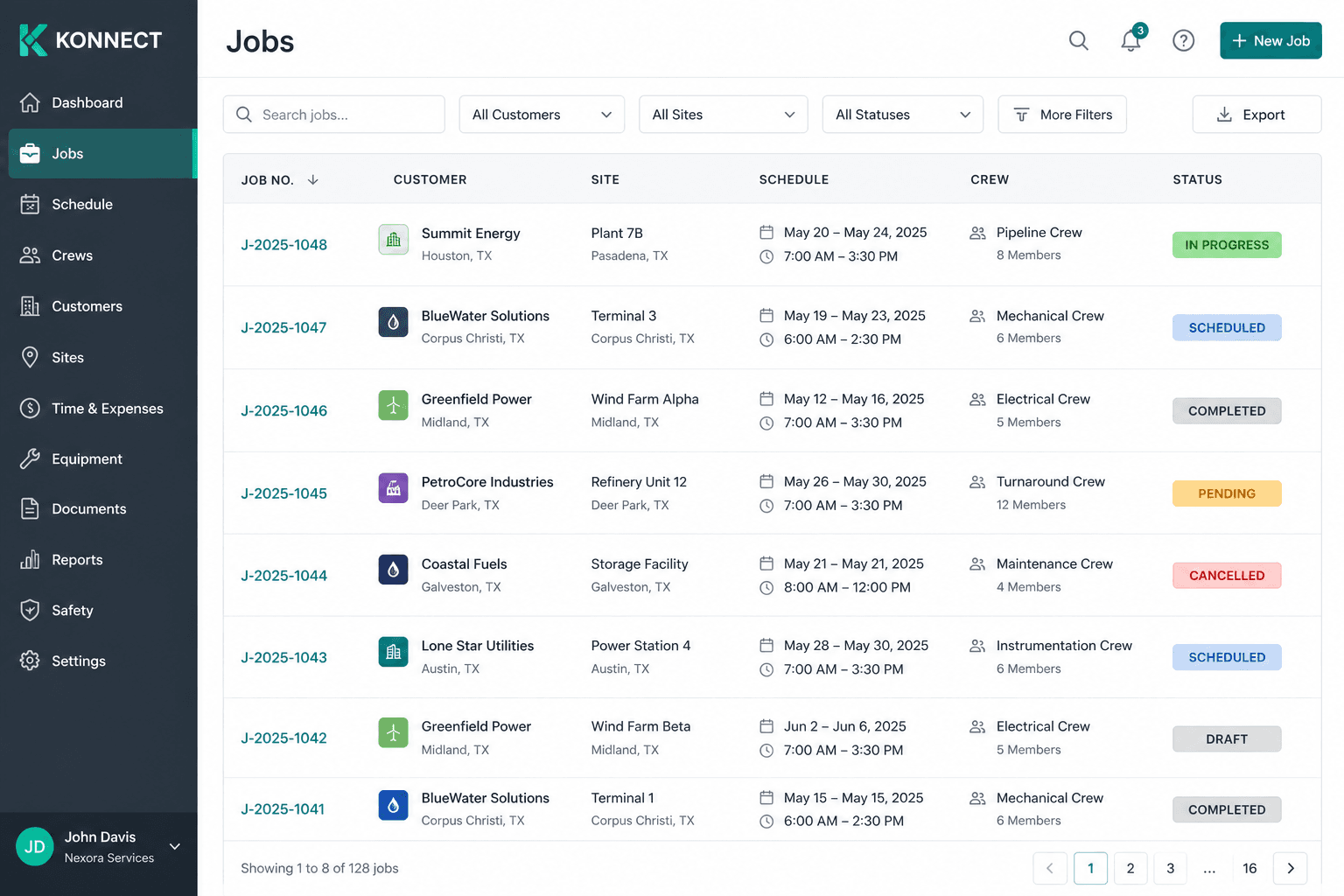
Almost every Indian field-service company starts on the owner’s phone. A group for each crew, a spreadsheet for outstanding, a PDF folder for quotes. That stack is fast when you are five people who sit in the same room. It is slow when you cannot answer “where is this job?” without scrolling.
WhatsApp here means chat-based operations — not a product integration. Excel means the parallel trackers that never quite match the chat. Knowing when that pair has peaked is an operating decision, not a software fashion.
TL;DR
- WhatsApp and Excel work until jobs, people, and inventory outrun shared memory.
- Switch when those costs are weekly, not because a vendor quoted a technician-count rule.
- Replace the stack with one job record from quote to payment — not with five new apps.
WhatsApp and Excel Work Surprisingly Well at First
Chat is immediate. The customer forwards a photo, you ping a technician, someone replies with a voice note. A spreadsheet of today’s jobs takes twenty minutes to build. For a founder-led crew, that loop is cheaper than any implementation project.
The tools fail later because they do not hold a job. They hold messages and cells. When the same work needs a quote, a part, a check-in, a photo, and a bill, the thread fragments. Nobody is wrong. The medium is wrong for that load.
The First Warning Sign: You Cannot Answer "Where Is This Job?"
A coordinator asks which jobs are open, who is on site, and what is blocked. The answer requires three groups, two spreadsheets, and a call. If that search is daily, you have already outgrown the stack — even if revenue still looks fine.
“Where is this job?” is not GPS. It is status, site, assignee, and next action on one record. When those live in different chats, you do not have operations. You have archaeology.
The Second Warning Sign: Information Lives in Multiple Chats
Sales quoted in one thread. Dispatch happens in another. The technician posts photos in a customer group. Finance asks for “the final amount” in a fourth. Each copy drifts. The customer hears a different scope than the helper bought parts for.
Retyping is the tax. Every extra paste is a chance to drop a serial, a floor number, or a promised time. Industry-specific versions of this pain — peak AC season especially — are spelled out in why AC jobs fail on WhatsApp.
The Third Warning Sign: Inventory and Jobs Do Not Match
The sheet says ten filters. The vans emptied more than that. Jobs completed “without parts” still used parts. Month-end count and billed work cannot be reconciled without blaming people.
When jobs and stock do not share a reference, you cannot tell leakage from growth. You order more, and the leak grows with volume. That is the moment Excel stops being a ledger and becomes a hope.
The Fourth Warning Sign: Owners Become the Operating System
If every exception routes to you — which technician, which price, which spare, which invoice — you are not leading the company. You are the message bus. Holidays become outages. Hiring another coordinator without a job record just adds another inbox.
Owner-as-OS feels like control. It is actually a single point of failure. The test is simple: can someone else dispatch tomorrow’s work from the same facts you use, without calling you?
The Fifth Warning Sign: More Technicians Create More Chaos
Adding people should add capacity. On chat, it adds groups, missed mentions, and “I didn’t see it.” Excel rows multiply; nobody owns a row. Chaos that scales with headcount is a process problem, not a recruiting problem. The growth version of this is scaling from five technicians to fifty.
The Real Cost of Disconnected Operations
The cost is not the price of WhatsApp. It is the work you redo.
- Retyping quotes, addresses, and part lists into jobs and invoices
- Missed information — site access, serials, promised times
- Duplicated records that disagree
- Delayed billing because proof lives in a customer chat
- Inventory leakage that cannot be tied to a job
- Poor accountability — nobody can show who checked in where
- Owner dependency for every exception
These costs are usually invisible in a monthly P&L line. They show up as overtime, discounts, and the feeling that you are busy but not ahead.
What a Structured Field-Service Operation Looks Like
Structure is a single path every job can follow, even when the commercial details differ.
- Customer
- Quotation
- Job
- Employee
- Materials
- Attendance
- Proof
- Billing
- Payment
Office work and field work still differ. The office creates and monitors the record. The field executes against it. Chat can remain for human conversation. It should not be the database.
That path is what Konnect’s feature set is organised around: quotations, jobs, tracking and attendance, inventory, proof, and payments — not a chatbot bolted onto a sheet.
When Should You Actually Make the Switch?
Ignore fake thresholds like “exactly twelve technicians.” Switch when several of these are true at once, and they are costing you every week.
- Multiple employees need the same job facts without calling the owner
- Multiple jobs run at the same time and status is argued about daily
- Inventory counts and billed jobs cannot be reconciled
- Billing waits on photos and signatures buried in chat
- Customer disputes repeat because evidence is not on the job
- The owner cannot see operations without opening the phone all day
- A second branch or a second dispatcher would copy-paste the chaos
- Administrative hours grow faster than revenue
If only one sign is true, tighten the current process first: one group per job is still a poor job record, but a named spreadsheet column for job number is better than none. If four or five signs are true, you are paying for software already — in people’s time.
What to Look For in a Field-Service Platform
Buy the job spine, not a feature catalogue. A useful checklist:
- One job number from quote (or direct job) through payment
- Field mobile for the assigned work, check-in, and proof — including poor signal
- Materials that can be reserved or issued to that job
- Attendance and location in the context of today’s open jobs
- Billing and outstanding on the same record as completion
- Office web for dispatch, stock, and finance — not a second set of facts
Compare options against that list, then look at plans and what you actually need to start. Starting with jobs and crew is valid. Adding quotations, tracking, stock, and payments on the same spine is the point — not ripping the company out every year.
For how that job record behaves day to day, see job management for field teams.
FAQ
When should a service business stop using Excel?
When spreadsheets cannot stay in sync with live jobs, stock, and billing — typically once multiple people update the same work and month-end no longer matches the field.
Is WhatsApp enough for managing technicians?
It is enough for conversation. It is not enough as the system of record for jobs, attendance, parts, proof, and invoices once several jobs run at once.
What should replace spreadsheets in field service?
A job-centred operations record that office and field share — quotes, dispatch, materials, proof, and payments — not another isolated tracker.
What features should field service software have?
At minimum: jobs, crew assignment, field execution, and a path to materials, attendance, proof, and billing on the same job. Extra modules should attach to that spine.
How can a small service company move from Excel to software?
Pick one painful flow (usually dispatch plus completion, or quotes plus jobs), run real jobs on it for a few weeks, then add stock or payments. Do not migrate every historical chat.