
Software decisions · 15 Aug 2026 · 8 min read
Field Service Software vs ERP: What Does a Growing Service Business Actually Need?
ERP and field-service tools both use the word “operations.” They are built for different centres of gravity. The useful question is where the job lives.
Growing service companies eventually sit through two sales pitches. One says you need enterprise resource planning because you buy, stock, and invoice. The other says you need field-service software because you dispatch people. Both can be sincere. They are not the same purchase.
This is not a takedown of accounting platforms or of lightweight job apps. It is a way to choose based on where the work actually fails today: in the van, in the store, or in the books — and whether those failures share a job number.
TL;DR
- Traditional ERP is strongest on administration, purchasing, stock ledgers, and accounting workflows.
- Field-service software must handle jobs, technicians, attendance, proof, and execution in the field.
- Feature count is a poor proxy for fit. Ask where the job record lives.
- Many growing companies need an operations-first platform, then accounting — not a warehouse of modules they will not run.
Why the Question Comes Up
You outgrow chat. You buy a tracker, a quoting tool, a billing tool. Then someone says “we should just get an ERP.” The impulse is healthy: you want one system. The risk is buying a system whose centre of gravity is the general ledger while your daily pain is “who is on JOB-1842, what did they install, and can we invoice?”
The question also comes up after a bad field-app experience: the map worked, the job did not. Owners then swing toward “serious” software. Serious is not the same as job-shaped.
What Traditional ERP Systems Are Designed to Control
In general terms — not as a review of any named vendor — ERP suites grew up around companies that plan materials, purchase, stock, and account for the business as a whole.
- Financial processes and period close
- Purchasing and vendor bills
- Inventory as a ledger
- Accounting and statutory reporting
- Business administration (masters, users, approvals)
Those capabilities matter. A service company that buys a lot of material still needs a purchase trail. The mismatch is when the first screen is a warehouse or a voucher, and the technician’s day is a workaround. ERP can include service modules. Many growing field businesses never reach the depth those modules assume, and they still need check-in, proof, and dispatch tomorrow morning.
What Field Service Software Must Handle
If people leave the building to do the work, the software must be good at that work — or the field will ignore it.
- Jobs with customer, site, status, and assignee
- Technicians and crew assignment
- Scheduling and dispatch
- Attendance and on-job presence
- Field execution on a phone, including poor signal
- Materials on the job
- Proof of completion
- Tracking in the context of today’s open jobs
Billing and inventory still belong. They should attach to the job, not replace it. A tool that only maps people is a tracker. A tool that only invoices is accounts receivable. Field-service software is the connective tissue. For a shorter version of this argument, see why one ops spine beats five apps.
The Problem With Choosing Software by Feature Count
A hundred modules can still miss the job. Feature lists are easy to inflate and hard to operate. If the crew will not complete proof in the app, the downstream invoice feature is decoration.
Fit is: can a dispatcher create or convert a job, assign a person, send them out, see they arrived, see what was used, see evidence, and raise a bill without retyping? If a demo cannot walk that path, the brochure does not matter.
This is also why leaving WhatsApp and Excel should not mean buying five specialist tools that recreate the same handoff tax.
The Most Important Question: Where Does the Job Live?
Draw your real path and ask which system owns each step.
- Customer
- Quotation
- Job
- Employee
- Materials
- Proof
- Billing
- Payment
If the job is a custom field in an accounting voucher, field execution will happen in chat. If the job is a card with no path to stock or outstanding, finance will rebuild it. The record that technicians open in the morning should be the record finance closes in the evening.
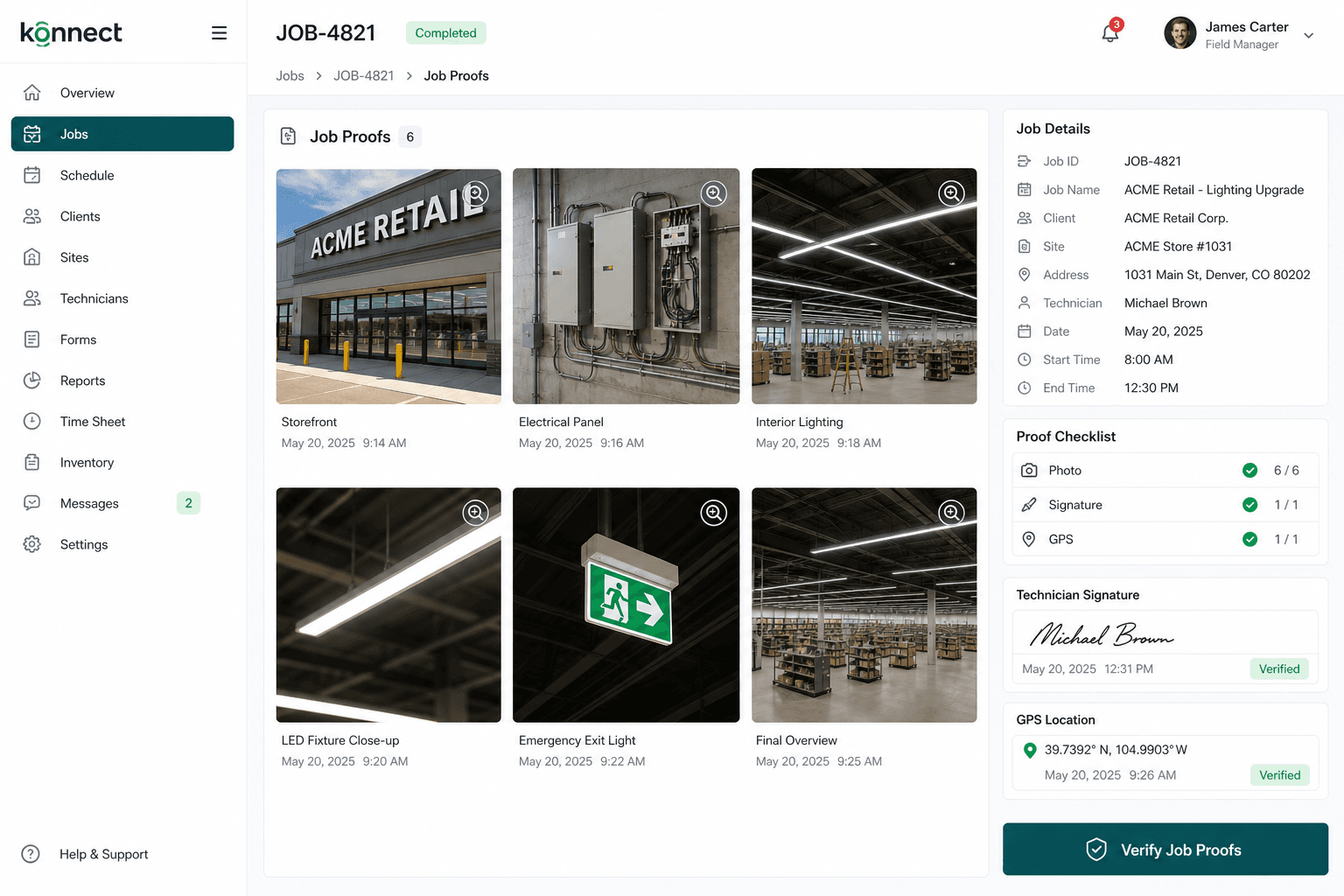
Walk that path on Konnect jobs in a demo: quote or create, assign, materials, proof, bill. Compare it to any ERP or tracker demo using the same script, not a feature matrix.
When a Service Business Needs Broader ERP Capabilities
You may need deeper administrative software when purchasing volume, statutory reporting, or multi-entity accounting is the constraint — and when those teams will actually live in that system. Examples: complex vendor programs, heavy warehouse operations beyond job issue, or finance processes your CA already runs in an accounting platform.
In those cases, an operations platform does not have to “replace ERP.” It has to own the job. Accounting can remain the book of record for the company while jobs, crew, proof, and job-linked stock run where the work runs. Forcing every technician into a full ERP client is how implementations fail.
When a Field Operations Platform Is the Better Starting Point
Start operations-first when the weekly pain is dispatch, attendance on the job, parts on the job, proof, and getting invoices out. That is most growing Indian field-service firms that still run on groups and sheets.
- Multiple technicians in the field every day
- Quotes or job cards that get retyped
- Stock that cannot be tied to billed work
- Disputes that need photos and location, not a status
- Owners who cannot see open work without the phone
You can add administrative depth later. You cannot easily sprinkle field adoption onto a system the crew already rejected. Start where the work moves.
What to Evaluate Before Buying
Use this as a buyer checklist in demos. Score the path, not the slide.
- Can a quotation become a job without retyping customer, site, and lines?
- Can the assigned technician open that job on a phone, including offline?
- Is check-in and location tied to the open job, not a separate tracker?
- Can materials be reserved or issued to that job? Can a local buy sit on it?
- Can proof close the job before invoice?
- Can you record full or partial payment against that same job?
- Will office users live in a web workspace for dispatch, stock, and outstanding?
- Is the vendor honest about what is not included (integrations, gateways, chat)?
Then look at Konnect’s features and pricing against that list. Start with the modules that match the leak. Same spine as you grow.
Why Konnect Takes an Operations-First Approach
Konnect is an operations platform for field-service businesses. It connects commercial work, field execution, employees, inventory, and billing on one job record — office web and field mobile. It is not a claim to replace every accounting platform or every ERP module a large group might run.
If your constraint is the job — quote to paid, crew on site, parts on the job, proof before the bill — that is the problem Konnect is built to hold. If your constraint is group accounting, keep the books where they belong and do not pretend a field app is a full finance suite.
FAQ
Is field service software an ERP?
Not in the traditional sense. ERP centres on enterprise administration and ledgers. Field-service software centres on the job, the technician, and completion. Some products overlap. The labels matter less than where the job lives.
Do field service companies need an ERP?
They need control of work, people, parts, and cash. That may be an operations platform plus accounting, or a larger suite, depending on purchasing and reporting complexity. Many growing firms do not need a full ERP to leave WhatsApp.
What is the difference between ERP and field service software?
ERP is typically strongest on finance, purchasing, and stock as ledgers. Field-service software is strongest on jobs, dispatch, attendance, proof, and field execution. Inventory and billing can exist in both; the design centre differs.
What should a growing service company choose?
Choose the system that can run tomorrow’s jobs with the crew you have, then attach stock and billing to that job. Add broader ERP capabilities when administration — not dispatch — is the bottleneck.
Can field service software manage inventory and billing?
It can when inventory issues, purchases, invoices, and payments attach to the job. That is job-linked operations, not a claim to replace every accounting workflow.