
Business Growth · 15 Aug 2026 · 9 min read
How to Build a Profitable Field Service Business Without Losing Operational Control
Revenue growth can hide weak jobs, leaking parts, and slow collections. Control is the four systems — sales, operations, workforce, and cash — sharing one job.
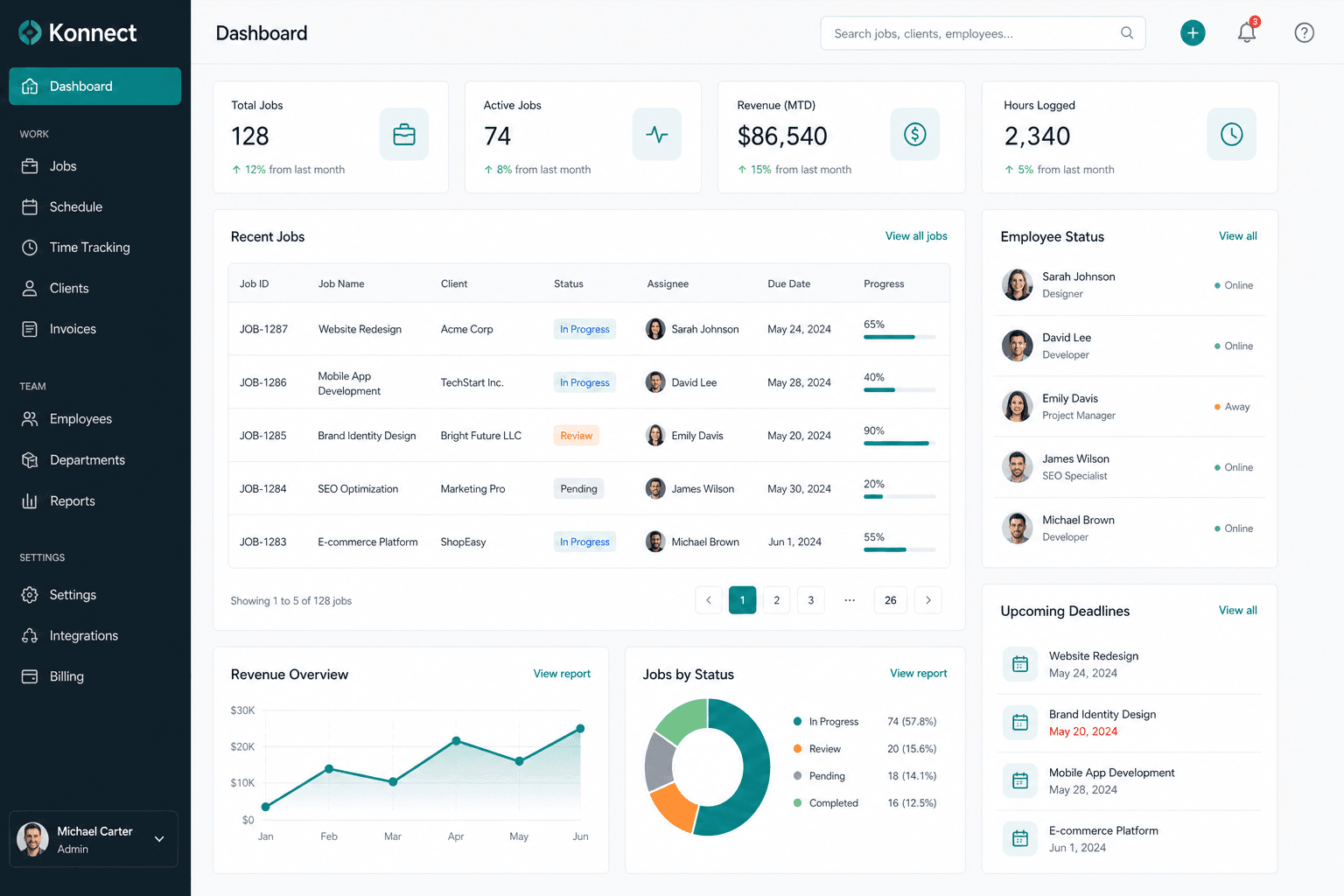
Growing a service company is easy to confuse with filling the calendar. More vans, more groups, more invoices. Profitability is quieter: did those jobs cover materials and labour, did proof land before the bill, and did cash actually arrive? Without operational control, growth adds hidden cost faster than it adds margin.
This is a management framework, not a promise that software prints profit. The aim is to connect sales, delivery, workforce, materials, and billing so you can see the business weekly — while you can still change it.
TL;DR
- Growth without a job spine hides cost in callbacks, parts, and uncollected invoices.
- Know a short weekly set of operating numbers — not a fantasy analytics suite.
- Build the connections before the company is too complex to retrofit.
Revenue Growth Can Hide Operational Problems
A busier month can still be a worse month. Discounted jobs, extra visits, parts that never hit the job, invoices that wait on a photo — none of that shows in “how many calls we took.” Owners feel it as cash tightness and overtime.
Control means you can explain last week’s work: what opened, what closed, what is stuck, what is unpaid, and whether materials followed the jobs. If you cannot explain it, you cannot improve it. You can only hire and hope.
The Four Systems Every Service Business Needs
You can name them departments or just habits. They must talk.
- Sales — customers, site visits, quotations, won work
- Operations — jobs, schedule, materials, completion
- Workforce — people, assignment, attendance, field execution
- Financial control — invoices, payments, outstanding, purchase cost on the job
Isolated excellence does not help. A beautiful quote that dies in chat, a disciplined crew with no job number, a store that issues to names, a finance folder of PDFs — each is a local win and a company loss.
Sales Must Connect to Delivery
Quoted scope should become the job. Customer, site, and line items should not be retyped from a screenshot. When they are, delivery invents a second BOQ and you will never know whether the margin problem was pricing or execution.
- Quotation
- Approved scope
- Job
Walk-in repairs can skip the quote. They should not skip the job. The rule is continuity where a commercial document exists, and a job record where work exists. See quotation software that converts to jobs for that handoff, and job-level profit for why the handoff is a money control.
Operations Must Connect to Workforce
A job that nobody is assigned to is a wish. A technician on site without a job is a story. Connect them.
- Job
- Employee
- Attendance
- Execution
- Proof
Attendance and check-in belong on the open job so you are not running a separate “HR GPS” and a separate work board. Proof belongs on the same job so completion is evidence. That is proof of work before you bill, not a status toggle in a sheet.
Materials Must Connect to Jobs
Stock that cannot name its job cannot name its cost.
- Stock
- Allocation
- Issue
- Consumption
- Return
Growing companies skip this because it feels like warehouse bureaucracy. It is how you keep growth from eating the store. Spare-part leakage is the detailed version; here the rule is shorter: no issue and no local buy without a job number.
Completed Work Must Connect to Billing
Finance should not invent the job at invoice time.
- Completion
- Approval
- Invoice
- Payment
Approval can be light — proofs present, customer signature, GPS stamp where you require it. Then the invoice is raised from that job, and payments (full or partial) reduce outstanding on the same record. Collections and purchase cost sitting together is the point of purchase and payments on the job.
The Operational Flywheel
When the four systems connect, you get a loop instead of a pile of tools.
- Sales
- Work
- Materials
- Proof
- Billing
- Cash
- Better planning
- More work
Better planning is not a slogan. It is last month’s job costs informing next month’s quotes, and last week’s overdue jobs informing how many you accept. The flywheel stalls wherever a handoff is a chat forward.
Five Numbers Owners Should Know Every Week
These are operating counts, not invented dashboards. If your tools cannot produce them, you still need the questions. Count them by hand until the record can.
| Weekly number | Why it matters |
|---|---|
| Open jobs | Load you have accepted and not finished |
| Overdue jobs | Promises slipping — capacity or process |
| Completed jobs | Throughput, not just activity |
| Outstanding amounts | Work converted to invoices that are not cash yet |
| Material / job cost visibility | Whether you can even see parts on the jobs you billed |
“Material/job cost visibility” is deliberately not a fake ROI metric. Either you can list materials on last week’s completed jobs, or you cannot. If you cannot, profitability talk is theatre.
Build Systems Before the Business Becomes Too Complex
Retrofitting a job spine onto fifty people and three unofficial van stores is possible. It is miserable. The cheaper time is when you still remember every customer and the pain of leaving WhatsApp and Excel is obvious.
Complexity arrives as a second branch, a second dispatcher, a second product line (AMC plus installs), or a crew that no longer fits in one group. Put the four connections in place before those land — then scaling the crew is adding people to a path, not inventing a path per person.
How Konnect Supports the Operating Model
Konnect is an operations platform for field-service businesses: quotations, jobs, employees and attendance, inventory and purchase, proof of work, and payments — office web and field mobile. It does not replace your accountant, and it does not guarantee margin.
Used as the job spine, it makes the four systems visible in one place so the weekly numbers are a review, not a scavenger hunt. Start where the leak is: jobs and mobile, or quotes and jobs, or stock on the job. Keep the same record as you add the rest.
Profit without control is a lucky month. Control without growth is a small company that knows its numbers. The useful combination is a job you can cost, a crew you can see, parts you can attach, and cash you can match to completed work — every week, not only when the CA asks.
FAQ
How do field service businesses become profitable?
Price against real job costs, stop leakage on parts and unbilled revisits, collect on completed work, and refuse to grow volume that you cannot see. Profit is a control habit, not a slogan.
What should a service business track?
Open, overdue, and completed jobs; outstanding amounts; and whether materials can be seen on the jobs you billed. Add labour cost when you can assign time to jobs.
How can field service businesses reduce operational costs?
Cut retyping, unrecorded issues, callbacks without evidence, and owner-as-dispatcher time. Those are costs even when they are not a P&L line.
How do you manage a growing service company?
Standardize the job path, delegate with shared facts, and review weekly exceptions. Headcount without that path multiplies chaos.
What systems does a field service business need?
Sales connected to jobs, jobs connected to people and materials, completion connected to billing and cash. Tools should serve those connections.