
Business Growth · 15 Aug 2026 · 9 min read
How to Scale a Field Service Business From 5 Technicians to 50
Scaling is not hiring more technicians. It is replacing memory and chat with a job lifecycle the tenth hire can follow without calling you.
Five technicians can run on the owner’s memory. Everyone knows the regular societies, the usual spares, and who is reliable on a Sunday. Fifty technicians cannot. The informal process that felt like culture becomes a bottleneck: you are still dispatching as if the company were small, while the payroll says it is not.
Headcount without a standard job lifecycle multiplies exceptions. The work of scaling is to make the common path boring — quote, assign, materials, execute, prove, bill — so exceptions are actually exceptional.
TL;DR
- Memory does not scale. A standard job lifecycle does.
- Stop being the dispatcher; give someone else the same job facts you use.
- Inventory mistakes get more expensive as volume grows — fix accountability before you hire the next ten.
- Office and field need different tools on the same record, not two truths.
Five Technicians Can Run on Memory. Fifty Cannot.
Small teams share context by sitting together. Large teams share context only if it is written on the job. When you add people without adding a record, you add coordination cost: more calls, more “I didn’t know,” more revisits.
The owner often notices this as calendar pain first — you are in every assignment decision — then as quality pain: two ways to close a job, three ways to collect a signature, no way to see who is on today’s open work without the phone tree.
Build a Standard Job Lifecycle
Write the path once. Train it. Change it on purpose, not per WhatsApp mood.
- Lead
- Quotation
- Job
- Assignment
- Materials
- Execution
- Proof
- Billing
- Payment
Not every job starts as a lead. Walk-in breakdowns can enter as a job. The point is that whatever the entry, the rest of the path is the same: someone is assigned, materials are accounted for, completion is evidenced, money is collected against that job.
That lifecycle is easier to run when it lives in one job record the office and field share rather than a new spreadsheet column per stage.
Stop Making the Owner the Dispatcher
Delegation is not “they can message me less.” It is “they can assign crew, date, and site from the same board I would use.” If only you know which technician is near Baner, you have not delegated dispatch. You have hired assistants for your memory.
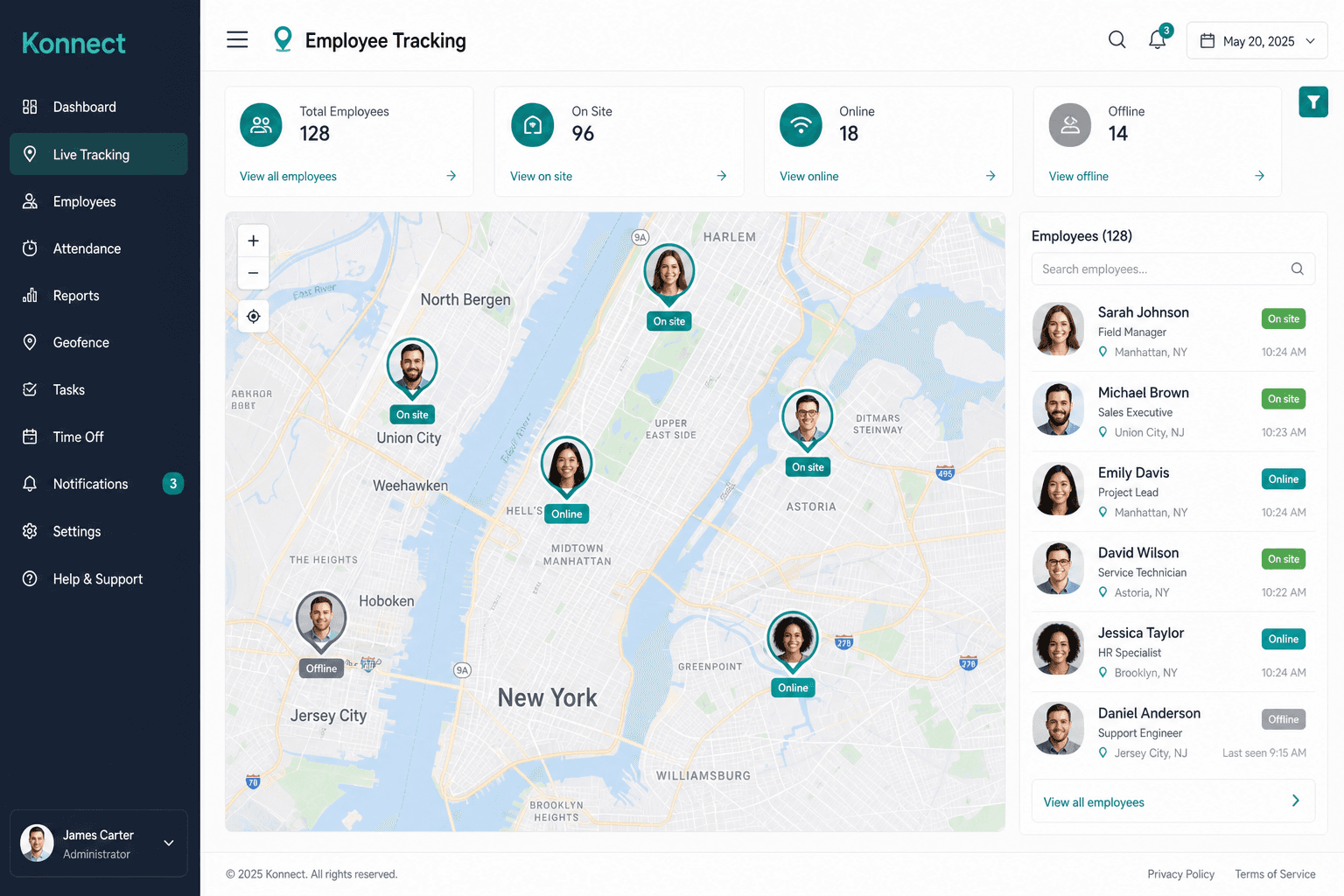
A dispatcher needs: open jobs, promised windows, who is already assigned, and a live sense of who is on site or en route for those jobs. Location without a job is a pin. Location on the open job is dispatch information — the distinction in job-linked tracking versus a GPS-only app.
Standardize Employee Operations
As the crew grows, “how we work” must be shorter than a folklore. Standardize the employee-facing loop even if commercial work stays varied.
- Assignment — the job appears on their list with site and scope, not a forwarded screenshot
- Attendance and check-in — policy-required presence on the job, not an honour system
- Schedules — today’s work is visible before they leave home
- Field mobile — start, navigate, update, close without calling the office for the basics
- Proof — photos and completion on the job, not in a customer group
The field mobile app exists for that loop: assigned jobs, check-in, proof, offline close-out. The office side of presence is employee tracking and attendance beside dispatch, not a second product the job never hears about.
Build Inventory Accountability Before You Grow
At five people, a missing filter is an irritation. At fifty, it is a pattern: vans as unofficial stores, emergency buys, jobs that cannot be costed. Volume multiplies whatever leak you already have.
Put materials on the job before you celebrate the next hiring round. Allocation, issue, local purchase, return — the same discipline described for spare-part control. Growing first and “fixing stock later” is how later never comes.
Make Every Job Have One Operational Record
The job number is the shared language. Customer, site, crew, materials, proof, invoice, outstanding: if they cannot point at the same number, you will hold meetings to translate.
One record does not mean one person does everything. It means sales, dispatch, store, field, and collections are not inventing parallel IDs. Parallel IDs are how fifty people create five versions of the truth.
Separate Office Work From Field Work
Office and field should see different screens of the same job.
| Side | Typical work |
|---|---|
| Office | Quotations, jobs, inventory, billing, monitoring open work |
| Employee | Assigned jobs, materials on those jobs, proof, attendance, field execution |
When you force technicians to use the office board, they will revert to chat. When you force the office to manage only from the phone, they will miss stock and outstanding. Split the interface; keep the record.
What Changes at 10, 25 and 50 Technicians?
The table below is a practical framework, not a universal rule. Some trades hit these pains earlier (high SKU count, multi-day installs). Use it to see what usually breaks, not as a hiring law.
| Team size | Operational challenge | What needs to change |
|---|---|---|
| ~5 | Owner still knows every job | Write the job lifecycle; stop unique processes per technician |
| ~10 | Owner is still the dispatcher | Shared job board; someone else can assign without a phone call |
| ~25 | Inventory and callbacks get noisy | Job-linked materials and proof before invoice; first-line supervisors |
| ~50 | The owner cannot see the business from chat |
Managers still have a span-of-control limit. Software does not replace a supervisor. It stops the supervisor from being a human copy-paste layer.
The Owner's Dashboard Changes
At five people the question is “who is working?” At fifty it is “what is happening across the business?” Open jobs, overdue jobs, jobs waiting on parts, outstanding amounts, crews that are dark on today’s work. You still care who is on site. You should not need to assemble that picture from twenty groups.
That shift is why scaling and WhatsApp-plus-Excel limits are the same conversation. Headcount is the amplifier. The record is the control.
If you remember one rule: do not hire the next ten people onto a process that only exists in your head. Write the lifecycle, put every job on it, and let supervisors run the common path while you handle pricing and exceptions. Fifty technicians can be quieter than five — if the work is on one record.
FAQ
How do I scale a field service business?
Standardize the job lifecycle, delegate dispatch with shared job facts, put materials and proof on the job, and split office/field interfaces before you keep hiring.
How many technicians can one manager handle?
There is no universal number. It depends on job complexity, travel, and how much of the work is on a shared record. If the manager is still retyping chat into a sheet, the span collapses quickly.
How do I manage 50 field technicians?
Supervisors plus a job board: assignment, attendance, materials, proof, and billing on one record. The owner reviews exceptions, not every ping.
How do I reduce owner dependency?
Make the job facts available without you: status, site, assignee, parts, and next action. Train a dispatcher against that board. Stay for exceptions and pricing, not for “where is Ramesh?”
How should field service businesses standardize operations?
Standardize the employee loop (assign, attend, execute, prove, close) and the office loop (quote or create, dispatch, stock, bill, collect). Allow variation in the commercial scope, not in whether the job exists.